Bail Application: 11 Proven Steps for a Fast Win
Bail Application: 11 Proven Steps for a Fast Win
By Charles Reece, Published by Reece Law Inc.
When every hour counts, a well prepared bail application can mean the difference between sleeping at home or in custody. Here is the clear, step by step playbook you can use right now. It is practical, fast, and designed for South African courts.
Because first impressions matter, your bail application must be precise, credible, and supported by documents. The court wants proof of stability, not speeches. With the right structure and timing, you can reduce risk, calm fear, and move quickly.
If you are helping a loved one, your role is crucial. Gather documents, line up sureties, and coordinate transport so the bail application runs on rails. Preparation beats panic every time.
Before we dive into the roadmap, remember this simple truth. A strong bail application is not about arguing the whole case. It is about showing the court that releasing you is in the interests of justice and that you will come back to face the trial.
What a bail application really decides
At its core, a bail application answers one question. Can the court trust the accused to return and not interfere with justice if released today. Everything else feeds into that decision, from your address to your job to your passport status.
Here is the key. A bail application is not a mini trial on guilt or innocence. You do not need to prove the full defence. You must show that the risks of release can be managed through conditions and an appropriate bail amount.
Because the court balances risk, your bail application should offer solutions. Think verified residence, frequent reporting, and a ban on contacting witnesses. These are levers that move the needle toward release.
Finally, remember the standard changes with the charge. For some offences, the State carries the burden. For others, you must show exceptional circumstances. Tailor your bail application accordingly.
Police bail vs court bail in South Africa
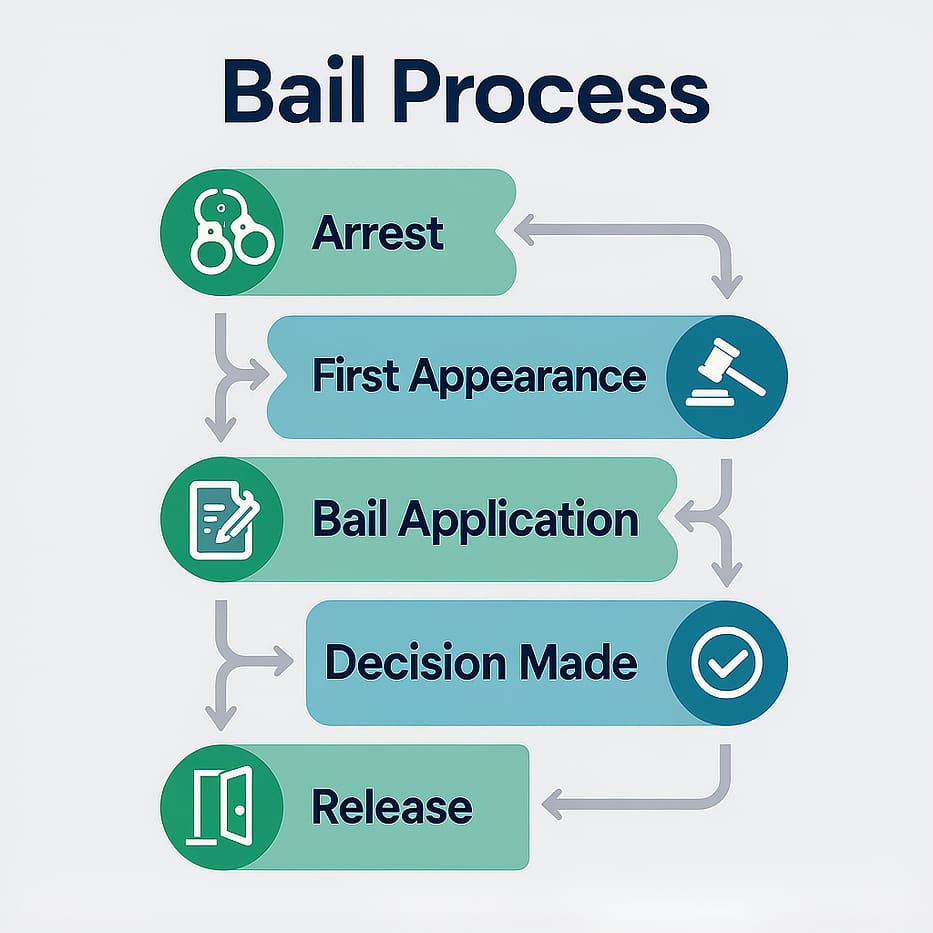
To work fast, you need the right forum. In minor matters, police bail may be possible at the station. For more serious charges, you will run a court bail application at first appearance. Ask your lawyer to confirm which path applies.
If police bail is available, a short, focused bail application at the charge office can get you home the same day. Documents still matter. Proof of address and employment can turn a hesitant officer into a yes.
If police bail is not available, prepare for a court bail application in the magistrates court that has jurisdiction. Timing is tight, so line up surety and documents early to avoid delays that push the hearing to another day.
Either way, treat the bail application as a formal legal process. Be respectful, speak through your lawyer, and avoid statements that touch the merits of the case.
The 11 step bail application roadmap
Use this roadmap to build a fast, credible bail application that addresses what courts care about and avoids common traps.
Step 1: Invoke your rights and call counsel
First, keep calm and use your right to silence. A single loose comment can complicate a bail application. Ask to contact your lawyer and share only the necessary basics for representation.
Next, get time and place clarity. Your lawyer can reach out to the investigating officer, check charge details, and plan the earliest slot for a bail application at the station or court. Speed here prevents a weekend in custody.
If you do not have a lawyer, call Reece Law Inc. for urgent help. A prepared team shortens the path to a successful bail application and protects your long term trial position.
Step 2: Build your document pack
A paper light bail application beats a messy bundle. Gather a verified proof of address, an ID copy, an employment or study letter, and two character affidavits. Keep originals and copies. Label everything.
Also, add a short means affidavit. Courts want an affordable amount that still ensures attendance. A well drafted means statement streamlines the bail application and prevents unrealistic figures.
Step 3: Choose the correct forum
Because forum errors waste time, confirm whether your bail application should be at the police station or in the magistrates court. Your lawyer will check the schedule of the alleged offence and local directives.
If police bail is an option, move fast with documents and a proposed amount. If not, prepare for a first appearance bail application with a concise affidavit and ready surety.
Step 4: Map the timeline and logistics
Timing wins cases. A bail application that starts early in the court day avoids postponements. Arrange transport for witnesses, bring funds, and know the cashier cut off times. Small logistics make big differences.
Also, plan for contingencies. If the investigating officer is not available, your lawyer can ask for a short stand down. The goal is to finish the bail application the same day whenever possible.
Step 5: Draft a tight applicant affidavit
A focused affidavit drives a fast bail application. Cover residence, employment, dependants, prior compliance, and a promise not to interfere with witnesses. Keep it factual. Avoid commentary on guilt or the strength of the State case.
Where possible, attach letters and copies rather than making long statements. A clean, well indexed bundle makes your bail application easy to grant.
Step 6: Anticipate and neutralise State objections
Strong preparation turns opposition into non issues. List the likely objections and answer each in your bail application. Flight risk is countered with fixed address, local ties, and passport surrender. Interference risk is countered with no contact conditions and clear work schedules.
Because prosecutors are practical, offer workable solutions. A thoughtful bail application that solves problems tends to land well with the court.
Step 7: Propose realistic conditions
Conditions are the heart of a risk managed bail application. Offer reporting at a nearby station, limits on travel, and a commitment to reside at a specified address. Add a ban on contacting witnesses or visiting sensitive sites.
Keep conditions practical. The court appreciates a bail application that balances freedom with accountability.
Step 8: Prepare funds and surety
Do not let payment mechanics derail a bail application. Confirm payment methods, amounts, and cashier hours. Bring identification for the payer. Keep copies of the receipt and any proof of electronic transfer.
Where a friend or family member will pay, have their affidavit ready. A smooth payment story supports a clean bail application and immediate release.
Step 9: Deliver focused submissions
When your matter is called, let your lawyer lead. A crisp, relevant bail application carries more weight than dramatic speeches. Stick to the interests of justice and the conditions that address risk.
If questioned, answer briefly and honestly. A measured tone and clear facts will elevate your bail application.
Step 10: Secure the order and confirm details
Once the court grants bail, capture the exact amount and each condition. Ask the court to state the next appearance date. A precise record prevents confusion and protects your bail application outcome.
If anything is unclear, ask respectfully for clarification. It is easier to fix now than later.
Step 11: Post order compliance and next steps
After payment, keep your receipt and record the conditions in writing. Share a copy with family. Your bail application bought freedom. Keep it by complying strictly and showing up early for every court date.
If a condition becomes unworkable, ask your lawyer to seek a variation. A proactive approach preserves the gains of your bail application.
Documents checklist for a smooth bail application
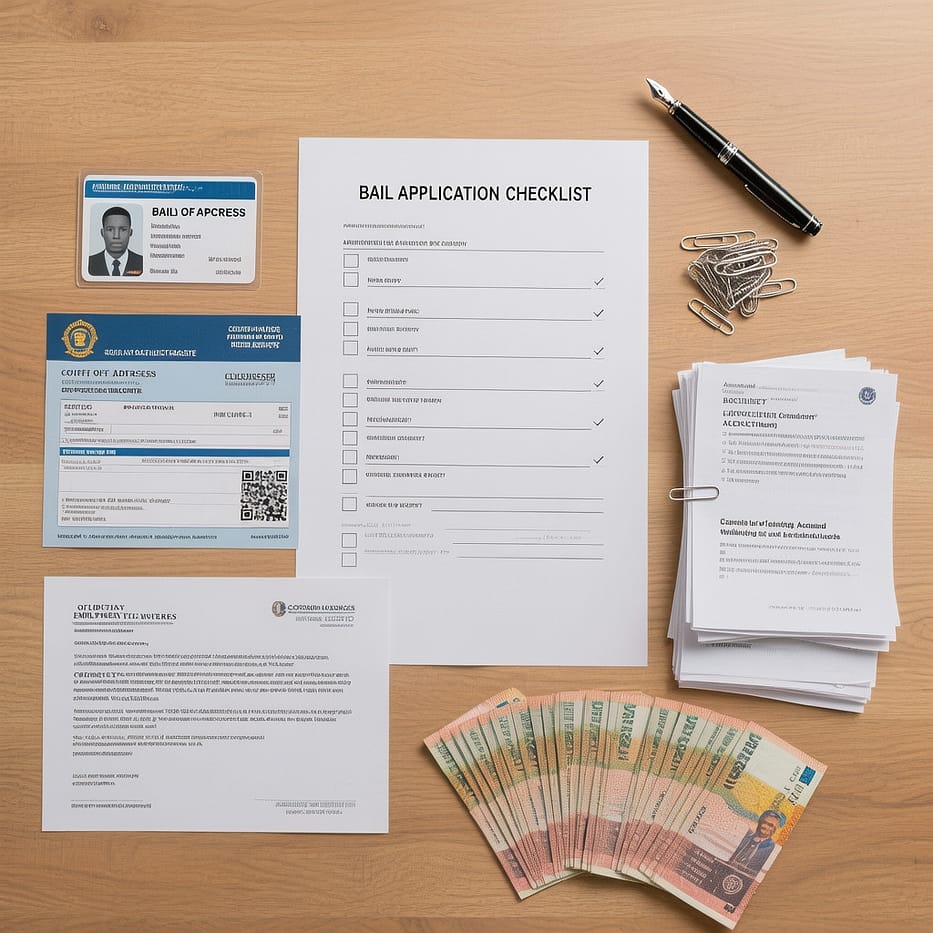
Because documents are proof, a tidy file speeds up a bail application and signals reliability. Use this checklist and tick each item as you pack it.
- Certified ID or passport copy
- Proof of address not older than 3 months
- Employment or study letter on letterhead
- Two character affidavits with contact details
- Means affidavit showing income and expenses
- Surety details and payer identification
- Passport for surrender if required
- Any medical notes for essential treatment needs
If a document is unavailable, say so plainly in the bail application and offer an alternative. Honesty beats overstatement and builds credibility with the court.
Costs, timing, and eligibility
Money, time, and risk drive every bail application. Plan each. Attorney fees vary with complexity. Straightforward matters can be handled quickly. Contested matters with multiple witnesses will take longer and cost more.
On timing, a same day bail application is often achievable in minor cases if documents and surety are ready. In more complex matters, expect a day or two of postponements for investigations or argument.
Eligibility hinges on the alleged offence and your personal circumstances. For many offences, the State must show why detention is needed. For serious offences under Schedule 5 or 6, you carry a heavier burden. Your bail application should reflect this shift with deeper facts and stronger conditions.

Common mistakes that sink a bail application
Avoid these traps and your bail application becomes easier to grant. Most are simple to fix with preparation.
- Arguing the full merits. A bail application is about risk, not guilt or innocence.
- No proof of address. Bring verified proof or a detailed affidavit from the homeowner.
- Unrealistic surety. Propose an amount you can actually pay so your bail application is not stalled at the cashier.
- Contacting witnesses. This raises interference concerns and undermines the bail application.
- Inconsistent employment claims. Provide a letter on letterhead with a contactable manager.
- Late arrival. A delayed start can push your bail application into the next day.
- Speaking without counsel. Offhand comments can harm both the bail application and the trial.
- Disrespect to court staff. Politeness and order help your bail application move faster.
Schedule 5 and 6 offences and your bail application
Serious charges change the rules. In Schedule 5 cases, you must show that the interests of justice permit release. In Schedule 6 cases, you must show exceptional circumstances. Your bail application must be deeper and better supported.
For these matters, expand your affidavit with detailed ties to the community, medical or family obligations, and concrete conditions that neutralise risk. A robust bail application for Schedule 5 or 6 treats every potential objection as a problem to solve.
Do not guess. Get expert advice and prepare witnesses and documents early. A credible, respectful bail application can still succeed in tough cases with the right structure.
Minors, students, and foreign nationals
Different profiles need different focus. For minors, a guardian or parent should support the bail application and provide proof of schooling and residence. Stability is the theme.
For students, study letters and class timetables help. For foreign nationals, surrendering travel documents, offering local sureties, and detailed accommodation plans make a bail application more persuasive.
After hours and remote options
Emergencies do not keep office hours. Some jurisdictions allow after hours police bail or weekend court sittings. Ask your lawyer to check what is possible to accelerate the bail application.
Where logistics allow, remote appearances or affidavits by consent can speed up parts of a bail application. Always confirm local practice before relying on this.
Digital hygiene during a bail application
Keep your phone clean and your messages brief. Screenshots and chats can appear in court. A wise bail application avoids digital clutter that confuses timelines and risks.
If police seize devices, do not offer passcodes without legal advice. Focus on the documents that improve the bail application rather than opening new fronts.
How courts assess risk in a bail application
Judicial officers are practical. They weigh ties to the community, prior compliance, gravity of the charge, the strength of the State case, and risk of interference. A good bail application speaks to each factor briefly and clearly.
Because flight risk is often central, focus on residence, work, dependants, and local commitments. Credible conditions show that your bail application reduces risk to manageable levels.
Conditions you can offer to secure a bail application
Think of conditions as levers you pull to unlock release. Offer what you can keep. A broken promise harms the bail application and invites a revoke.
- Report to a specified police station on set days and times
- Reside at a fixed address and notify the IO before any move
- Do not contact certain people or visit identified places
- Travel only within a defined area unless the court approves
- Surrender passports and firearms if applicable
- Attend court early and sign attendance at each appearance
If you are unsure which conditions fit, ask your lawyer to tailor a bail application that balances your life and the court’s concerns.
If your bail application is refused
Do not panic. Ask for reasons to be placed on record. Your lawyer can prepare an appeal or a new bail application based on new facts. Timing is strategic. Move when your evidence is stronger, not just faster.
In the meantime, keep gathering documents. Maintaining a respectful attitude makes the court more receptive to the next bail application.
Compliance after your bail application succeeds
Protect your win. Save your receipt, calendar every date, and set reminders. If a work trip clashes with court, ask your lawyer early to adjust conditions. Your bail application can be varied if you act before a breach occurs.
If you face hardship, document it. Courts respond to facts and solutions. Your goal is simple. Keep the benefit of your successful bail application intact until trial is completed.

Need hands on help right now
If minutes matter, experienced counsel can streamline a bail application and avoid costly missteps. You can reach our team for swift guidance and representation.
For urgent assistance with a bail application, contact Reece Law Inc.. We are available to coordinate documents, surety, and timing so your matter is heard promptly and professionally.
Prefer to set a meeting. Book a consultation via this page (placeholder URL to verify) and include your case details so we can prepare an efficient bail application plan.
Technical note for readers
To keep this guide fast and accessible on mobile, images are compressed and caching is recommended on your device or browser. A speedy page helps you scan and act while you organise a bail application under pressure.

FAQs
How long does a bail application take in South Africa
Simple matters can finish the same day if documents and surety are ready. Contested cases take longer. A realistic plan can keep a bail application from slipping into another day.
What determines the amount of bail
Courts set an amount that ensures attendance without being punitive. Your bail application should include a means affidavit and proposed conditions to support an affordable figure.
Can a bail application be repeated if refused
Yes. You can appeal or bring a new bail application based on new facts. Ask your lawyer which route is faster and stronger for your case.
Do I really need a lawyer for a bail application
You can speak for yourself, but a lawyer trims risk and speeds the process. A structured bail application backed by evidence outperforms ad hoc oral requests.
What are common bail conditions
Reporting to a station, living at a fixed address, travel limits, no contact with witnesses, and surrendering passports are frequent. Your bail application should propose workable versions of these.
What if I cannot afford the proposed bail
Ask the court for a lower amount with reasons. A detailed means statement and tighter conditions can keep a bail application affordable without increasing risk.
Can foreigners get bail in South Africa
Yes, with careful planning. Surrender travel documents, present local sureties, and provide verified accommodation so the bail application addresses flight risk.
What happens if I breach bail conditions
Bail can be revoked and funds forfeited. If life changes, ask for a variation before a breach so your bail application result remains intact.
Final word and next steps
Act early, prepare documents, and keep your bail application laser focused on risk and conditions. That is the formula for speed and success in South African courts.
For time sensitive help with a bail application, email info@reece-law.co.za or call 073 621 0822 or 031 945 9505. You can also contact Reece Law Inc. or use our contact page (placeholder URL to verify). Subscribe, comment, or share this guide to help others who need a fast, fair bail application.
References
Constitution of the Republic of South Africa 1996 – Rights of arrested, detained and accused persons
Criminal Procedure Act 51 of 1977 – Bail provisions overview




Post Comment